
CASE STUDIES / SYNCHRONY
Building a brand from invisible infrastructure to consumer meaning.
Finance should be transformational, not transactional.
What Remains True
A brand without a strategic foundation is just a logo with rules.
The most consequential strategic decision is often not just about the campaign. It is defining the meaning the campaign has to express.
The Result
Synchrony moved from a fragmented style guide to a complete brand system: a defined essence, manifesto, personality, voice, visual identity, and campaign platform, all supported by a strong brand governance team and disciplined process.
Agencies and internal teams now operate against a clear strategic standard. The platform was designed to scale across partners, products, and channels without dilution.
The approach
My role was to define what Synchrony stood for before anything else could move, then hold every creative decision against that standard.
I built a team of exceptional leaders across brand strategy, brand marketing, and brand governance. Working with internal teams and agency partners, we developed a complete brand platform built around a single idea: the full worth of everyday life. Not financial products. Not credit. The meaning behind why everyday things matter to real people.
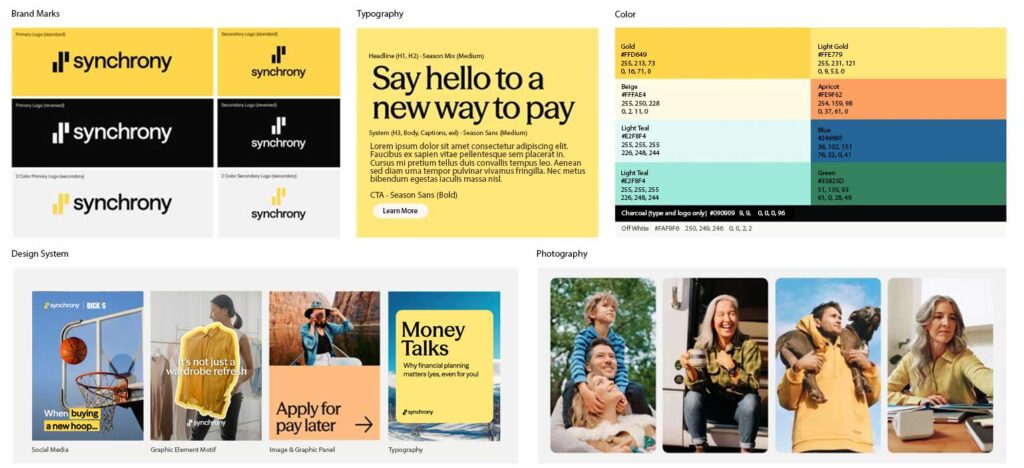
That platform had to work across marketing, sales, investors, employees, policy, and strategy. The brand architecture placed brand at the center, informing all of those simultaneously.
From that foundation, my role was to ensure every agency output laddered back to the brief, and the brief laddered back to the platform. The test was specific: does this help the consumer get the most value out of the everyday? Work that could not answer that clearly went back.
That filter shaped the campaign “Everyday Well Spent” and established the foundation for every execution developed against the platform.
the core tension
Synchrony needed to build consumer visibility and emotional relevance without threatening the 400+ partner relationships that defined its business.
Make the brand too prominent and partners feel displaced. Stay invisible and the brand builds no equity.
The tension was between becoming known to consumers and remaining safe for the partners who needed to stay in front.
The Disconnect
Synchrony is a Fortune 200 financial services company, and most consumers had never heard of it. By design. Synchrony facilitated transactions through private label credit cards across 400 partners, meaning the consumer saw the retailer’s card, not Synchrony’s name. For a B2B enterprise, that invisibility was a feature.
But growth required becoming consumer-facing without disrupting the partner relationships that made the model work. There was no brand foundation to build from. What existed was a style guide, not a strategy. No essence. No manifesto. No defined personality or voice. No platform that could inform marketing, products, policy, employees, investors, and strategy simultaneously.